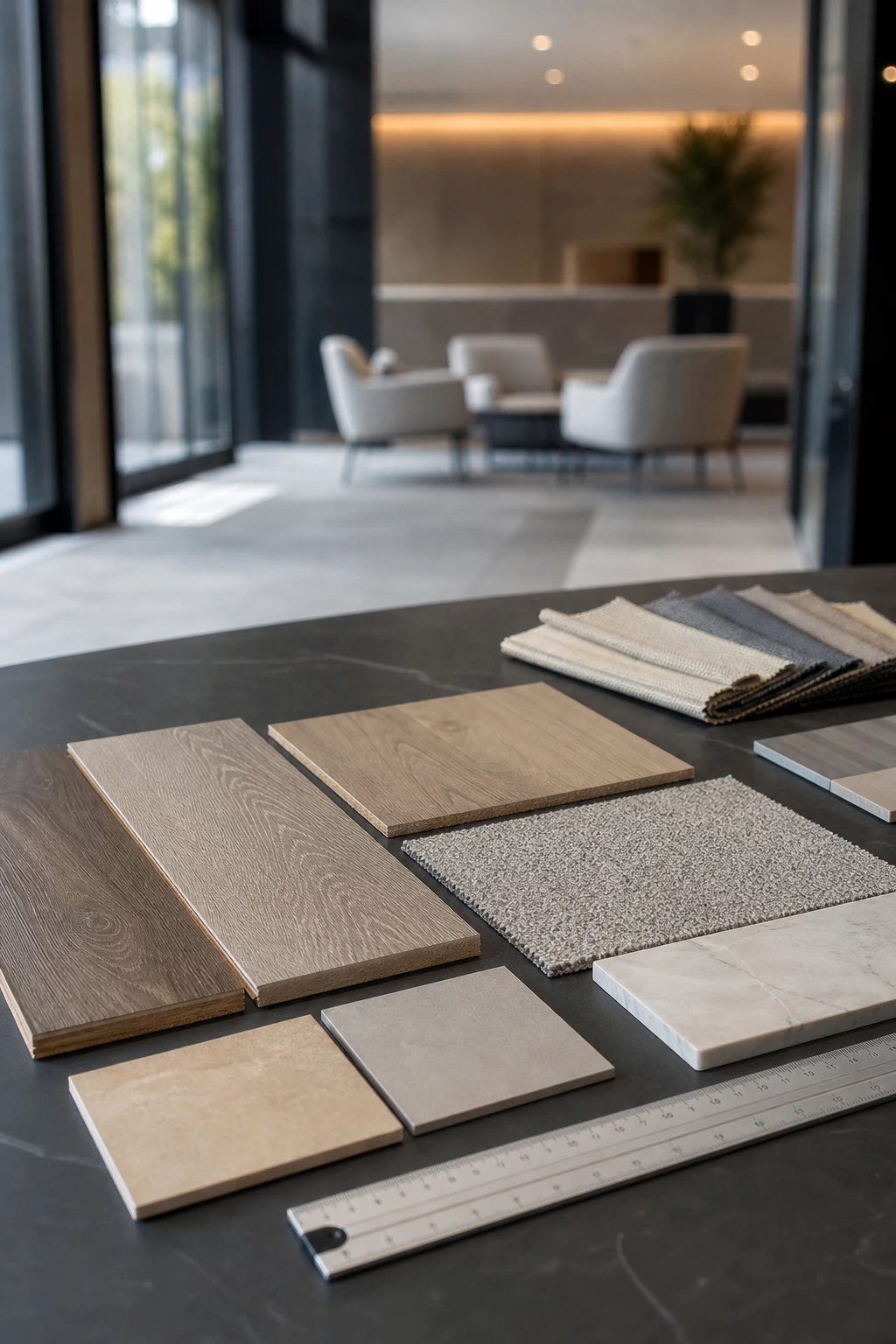

When a project calls for resilient flooring that balances design flexibility with long-term durability, commercial LVT consistently rises to the top of the specification list. Commercial LVT is a multi-layer vinyl flooring product that is engineered to withstand the sustained foot traffic, rolling loads, and aggressive cleaning cycles found in professional environments. It offers significant advantages over traditional hard-surface options: waterproof surface performance, lower lifecycle cost than hardwood or stone, rapid installation that minimizes facility downtime, and a design library broad enough to replicate wood, stone, or abstract visuals with photographic precision. However, it also carries limitations that specifiers must acknowledge — it cannot be refinished like solid hardwood, it is susceptible to indentation under concentrated point loads, and its long-term performance depends entirely on correct installation and adhesive selection. Understanding both sides of this equation is the foundation of a sound specification. The sections that follow break down every technical parameter a buyer should verify before committing to a commercial LVT purchase order.
What Separates Commercial-Grade LVT from Residential Vinyl Flooring?
Commercial-grade LVT is a resilient floor covering that is defined by measurable ASTM performance thresholds rather than marketing labels. It must withstand sustained rolling and static loads, resist surface cracking under impact, maintain dimensional stability across temperature fluctuations, and survive aggressive cleaning cycles — requirements that residential products are simply not engineered to meet.
Four ASTM benchmarks draw the line between commercial and residential grade. Impact resistance testing (ASTM D5420) simulates dropped tools and equipment striking the surface; commercial products must show no cracking. Static load resistance (ASTM F970) measures the ability to bear fixed furniture, shelving, and equipment without permanent indentation — the commercial threshold starts at 1,000 PSI, with heavy-duty environments demanding 2,500 PSI or higher. Rolling load endurance (ASTM F2753) tests resistance to wheeled carts, hospital beds, and pallet jacks, requiring tolerance above 1,000 pounds. Dimensional stability (ASTM F2199) ensures the product will not expand or contract beyond 0.25 percent as temperature and humidity shift — a critical parameter in large open-plan commercial spaces where even minor movement accumulates across hundreds of square meters.
When residential-grade products are installed in commercial environments, failures follow predictably. Thinner wear layers erode within months under heavy foot traffic. Lower-density cores develop visible indentation beneath rolling office chairs. Click-lock systems designed for bedroom-scale rooms lose seam integrity across expansive commercial floor plates. Worse, installing a residential product in a commercial setting typically voids the manufacturer’s warranty entirely — leaving the buyer with no recourse when problems appear.
Which Wear Layer, Thickness, and Core Specifications Should a Commercial LVT Buyer Require?
The wear layer is the transparent polyurethane shield that protects the decorative print beneath it. In commercial LVT, this layer determines how many years the floor will maintain its appearance under daily abuse.
A 20-mil wear layer suits light commercial environments such as small offices and boutique retail. A 28-mil layer handles moderate-to-heavy traffic found in schools, medical clinics, and mid-volume retail. A 40-mil layer serves the most demanding environments — hospital corridors, airport terminals, and logistics facilities. However, mil thickness alone does not tell the full story. Surface coating technology matters equally. Ceramic-bead-enhanced urethane coatings dramatically outperform standard urethane in scratch and scuff resistance. Two products with identical mil ratings can deliver vastly different field performance based on this single variable. Buyers should require coating composition details — not just thickness — in every specification document.
Total product thickness ranges from 2.5 mm to 5 mm or more, and the choice depends on project conditions. When to choose a 2.5 mm thin-profile product: renovation projects where door clearance is limited and transition heights to adjacent flooring must be minimized. When to choose a 4–4.5 mm standard-profile product: new construction where subfloor imperfections need to be masked and rolling load performance is a priority. When to choose a 5 mm or thicker product: projects requiring floating installation for speed, or temporary-to-medium-term commercial fit-outs.
Core material further differentiates performance. An SPC (stone polymer composite) rigid core is an ultra-dense substrate that is composed of limestone powder and PVC resin fused under high pressure — it delivers maximum indentation resistance and dimensional stability. A flexible PVC core offers superior conformity to minor subfloor irregularities but provides less resistance to point loads. Fiberglass-reinforced cores balance dimensional stability with acoustic comfort in floating installations.
Edge profile is an overlooked specification detail. Beveled edges should always be factory-applied — field-cut bevels produce inconsistent results. Straight edges create a tighter visual seam but show subfloor imperfections more readily. The specification should state the edge profile explicitly to avoid substitution during procurement.

What Subfloor and Moisture Conditions Must Be Verified Before Commercial LVT Installation?
Subfloor preparation is the single most common cause of commercial LVT failure — and the single most common reason warranty claims are denied. ASTM F710 requires the concrete substrate to be permanently dry, structurally sound, and flat within 3/16 inch per 10 feet before any resilient flooring is installed.
Moisture testing is mandatory, not optional. The in-situ relative humidity test (ASTM F2170) is the preferred method: probes are placed within the slab to measure internal moisture conditions. If readings exceed the manufacturer’s stated threshold — which varies from 75% RH to 95% RH depending on the product and adhesive system — a moisture mitigation system must be installed before the flooring goes down. These systems typically consist of two-component epoxy or urethane coatings applied directly to the slab surface per ASTM F3010. The calcium chloride test (ASTM F1869) remains an alternative for surface-level emission rate measurement, though it is less precise for thicker slabs.
Beyond moisture, surface preparation determines bond integrity. Residual adhesives, curing compounds, paint, and sealers must be completely removed — any contaminant between the substrate and the new adhesive creates a weak plane where delamination begins. Self-leveling compounds used to correct flatness defects require their own curing period before adhesive application; rushing this step is a frequent source of failure.
Acclimation is equally critical. Flooring materials should be stored in the installation space for a minimum of 48 hours to reach equilibrium with room temperature and humidity. Proper expansion gaps around the perimeter — per the manufacturer’s published guidelines — prevent buckling that exposes moisture pathways to the subfloor.
Which Adhesive System and Slip Resistance Rating Does a Commercial LVT Project Require?
The adhesive system is the structural connection between the product and the subfloor. Selecting the wrong type — or using a non-approved product — can void the warranty regardless of how well the flooring itself performs.
Three adhesive methods serve different commercial scenarios. When to choose full-spread adhesive: any heavy commercial installation where rolling loads, high foot traffic, and maximum dimensional stability are required — this is the industry default. When to choose perimeter adhesive: lighter commercial environments using thicker (4 mm+) products where full-spread coverage is unnecessary. When to choose pressure-sensitive adhesive: installations over non-porous substrates or raised access flooring — though this method is generally unsuitable for areas subject to rolling loads.
Manufacturer-specified adhesive is almost always a warranty condition. Using an alternative product — even a premium one — can void coverage entirely. The specification document should name the approved adhesive by product code, not just by generic type, and the adhesive’s PSI rating must match or exceed the flooring product’s rolling and static load specifications.
Slip resistance is a safety and liability requirement. In North America, commercial floors must achieve a Dynamic Coefficient of Friction (DCOF) of 0.42 or higher on wet surfaces per ANSI A326.3. European projects reference DIN 51130 R-ratings, where R10 covers general commercial areas and R11 or R12 serves wet zones such as commercial kitchens and pool surrounds. ADA guidelines recommend DCOF of 0.60 for level surfaces and 0.80 for ramps. Specifiers should verify that the selected product meets the slip resistance standard applicable to the project’s jurisdiction — and should note that slip performance can degrade as the wear layer thins over the product’s lifetime.
What VOC Certifications and Environmental Compliance Standards Apply to Commercial LVT?
Volatile organic compound (VOC) compliance is no longer a differentiator in commercial flooring — it is a baseline expectation. Specification documents must identify which certifications the project requires and verify that the selected product holds current, valid credentials.
FloorScore certification is a third-party program that verifies indoor air emissions comply with California Section 01350 limits — the most widely referenced standard in North American commercial construction. GreenGuard Gold applies stricter thresholds and is typically required for sensitive environments such as schools, childcare facilities, and healthcare buildings. An Environmental Product Declaration (EPD) is a standardized, third-party-verified document that quantifies a product’s environmental impact across its entire lifecycle — from raw material extraction through manufacturing, use, and disposal. EPDs are now expected for LEED v4.1 Material and Resources credits and are increasingly required in government procurement specifications.
Recycled content also factors into specification decisions. Pre-consumer recycled content (manufacturing waste reintegrated into production) and post-consumer recycled content (recovered end-of-life material) carry different weight in green building rating systems. Projects targeting specific LEED, BREEAM, or WELL credits should confirm the manufacturer’s recycled content percentages and verify them through documentation — not marketing claims.
Which Warranty Clauses Create the Most Risk for Commercial LVT Buyers?
A commercial LVT warranty is a legal document, not a marketing promise. The clauses that generate the most disputes are the ones buyers least expect.
The definition of “wear-through” is the most consequential clause. Most manufacturers define wear-through strictly as complete erosion of the wear layer to the point where the decorative print film becomes visible. This means gloss reduction, surface scratching, scuff accumulation, minor discoloration, and shallow indentation are all explicitly excluded from coverage — even though these are the conditions that most often prompt replacement in practice. Buyers who assume that visible deterioration equals a valid warranty claim are routinely denied.
Proration is the second major risk. A “15-year commercial warranty” may sound robust, but if proration begins in year three, the actual reimbursement value declines steadily each year. By year ten, the manufacturer’s obligation may be a fraction of the original material cost. Labor cost coverage is often even shorter — many warranties cover full labor replacement only for the first one to two years, then shift to partial or zero coverage. The “sole remedy” clause — standard in most commercial warranties — limits the manufacturer’s maximum liability to product replacement or refund, never full project remediation.
Installation compliance is the warranty’s kill switch. Failure to use the specified adhesive, failure to perform documented moisture testing, failure to acclimate the product, or installation in conditions outside the manufacturer’s stated temperature and humidity range — any single violation can void the entire warranty. Buyers should maintain detailed installation records including moisture test results, adhesive batch numbers, acclimation logs, and site condition photographs. These documents are the only defense if a dispute arises.
Frequently Asked Questions About Specifying Commercial LVT
What is the minimum wear layer for heavy commercial use?
Heavy commercial environments require a minimum 28-mil wear layer with ceramic-bead-enhanced urethane coating. Light commercial spaces can use 20 mil.
Can click-lock LVT replace glue-down in large commercial spaces?
In most cases, no. Full-spread glue-down provides superior dimensional stability and rolling load resistance across large floor areas. Click-lock systems are better suited to smaller or temporary installations.
How long should commercial LVT acclimate before installation?
A minimum of 48 hours in the installation space at the manufacturer’s specified temperature and humidity range.
Does commercial LVT require a moisture barrier on every concrete subfloor?
Not always, but moisture testing is always required. A barrier is necessary only when test results exceed the manufacturer’s stated thresholds.
What fire rating does commercial LVT need for building code compliance?
Most jurisdictions require a minimum Critical Radiant Flux of 0.45 W/cm² per ASTM E648 for commercial corridors and exits.
Is a residential LVT warranty valid for light commercial use?
Almost never. Residential warranties explicitly exclude commercial applications, even low-traffic ones.
Specifying commercial LVT is not a matter of choosing the most attractive design — it is a technical verification process. From ASTM performance benchmarks and subfloor moisture testing to adhesive selection and warranty clause analysis, every overlooked parameter carries the potential for installation failure or denied claims. Buyers who treat the specification as a binding technical document — rather than a product brochure — protect both the project and their investment.