Every basement floor project carries hidden risk. Concrete slabs push water vapor upward all year. Humidity swings crack weaker materials. A small leak can ruin a full installation within months. This is why “waterproof flooring for basements” is not a marketing label. It is a structural decision.
Waterproof vinyl plank now makes up over 60% of all resilient flooring sales in the United States, according to the Resilient Floor Covering Institute (2024). The surge is driven by basement renovations, where failure rates for older products stay high.
This guide does three things. First, it explains the moisture science that makes basements different. Second, it shows why SPC flooring performs best below grade. Third, it lists the failure modes that cause the most callbacks — and how to prevent them.
What Makes a Basement So Different from the Rest of the House?
Basements sit below grade against damp soil. Concrete slabs release water vapor year-round. Temperature swings drive condensation. Hydrostatic pressure pushes groundwater through micro-cracks. These four forces make basements the hardest environment in a home for any flooring material.
Where does below-grade moisture actually come from?
Four moisture sources act on a basement slab at the same time.
Hydrostatic pressure pushes groundwater upward through concrete. This force grows stronger after rain or snowmelt.
Vapor drive moves water molecules through the slab every day. Even a dry-looking basement can release 8 to 14 pounds of water vapor per 1,000 square feet per 24 hours.
Condensation forms when warm air meets cool concrete. In summer, the slab stays cooler than the room air, and water builds on any cold surface.
Seasonal flooding or plumbing leaks add liquid water events on top of the baseline vapor load.
Why do moisture, mold, and mildew make basements fail faster than any other room?
Mold spores need only three conditions: moisture, still air, and organic material. Basements supply all three. Carpet pads trap moisture. Wood subfloors feed mold growth. Fiber-core products swell and crack within weeks of exposure.
The damage is not only cosmetic. Trapped moisture under a finished floor creates adhesive failure, edge curl, and musty odors that travel into living spaces. Choosing the right flooring is the first line of defense.
What Does “Waterproof Flooring for Basements” Actually Mean?
Waterproof basement flooring is any product with a 100% non-absorbent core that resists standing water, vapor drive, and humidity swings without swelling. True waterproof products carry test data under ASTM F3261, FloorScore, and related standards.
How is waterproof different from water-resistant and fully submersible?
The three terms describe three different performance levels.
● Water-resistant products handle surface spills for a short time. They fail under sustained vapor drive.
● Waterproof products have a 100% non-absorbent core. They do not swell, warp, or delaminate after 24 to 72 hours of direct water contact.
● Fully submersible is a stricter category for commercial wet zones. The floor system, including seams, can stay submerged indefinitely without damage.
For basement use, “waterproof” is the correct minimum. Water-resistant is not enough.
Which certifications and lab tests should specifiers look for?
A real waterproof claim is backed by four test families.
| Standard | What it measures | Why it matters for basements |
| ASTM F3261 | Rigid-core flooring performance | Confirms dimensional stability and lock-joint integrity |
| ASTM F1869 | Calcium chloride moisture vapor emission rate | Measures slab moisture before installation |
| ASTM F2170 | Relative humidity probe inside concrete | Modern standard; more accurate than calcium chloride |
| ASTM E1745 | Vapor retarder permeance and strength | Governs the 6-mil to 15-mil poly sheets under the floor |
| FloorScore / Indoor Air Comfort | Low-VOC indoor air emissions | Protects air quality in closed basement spaces |
Ask your supplier for the full test reports, not just a logo. A real manufacturer sends the PDF within 24 hours.
Why Is SPC Flooring Often the Safest Choice for Basement Installations?
SPC flooring is a rigid-core vinyl plank that uses a dense mineral-polymer composite core made from limestone powder and PVC. The core contains no wood fiber, absorbs less than 0.5% water by weight, and stays dimensionally stable from −20°C to 60°C.
SPC works in basements because its limestone-polymer core is 100% non-absorbent, dimensionally stable across temperature swings, and strong enough to bridge minor slab imperfections. A 4.0 to 6.0 mm plank with a 20 mil wear layer handles most below-grade conditions.
How does the stone-polymer core resist moisture and stay dimensionally stable?
The SPC core is roughly 60% to 75% calcium carbonate by weight. This mineral content gives the plank three properties basements need.
● Zero water absorption in the core. Water contact does not trigger swelling.
● Low thermal expansion, around 25 × 10⁻⁶ /°C. Planks stay flat when the slab warms or cools.
● High density, around 1.9 to 2.1 g/cm³. The floor does not telegraph minor slab unevenness.
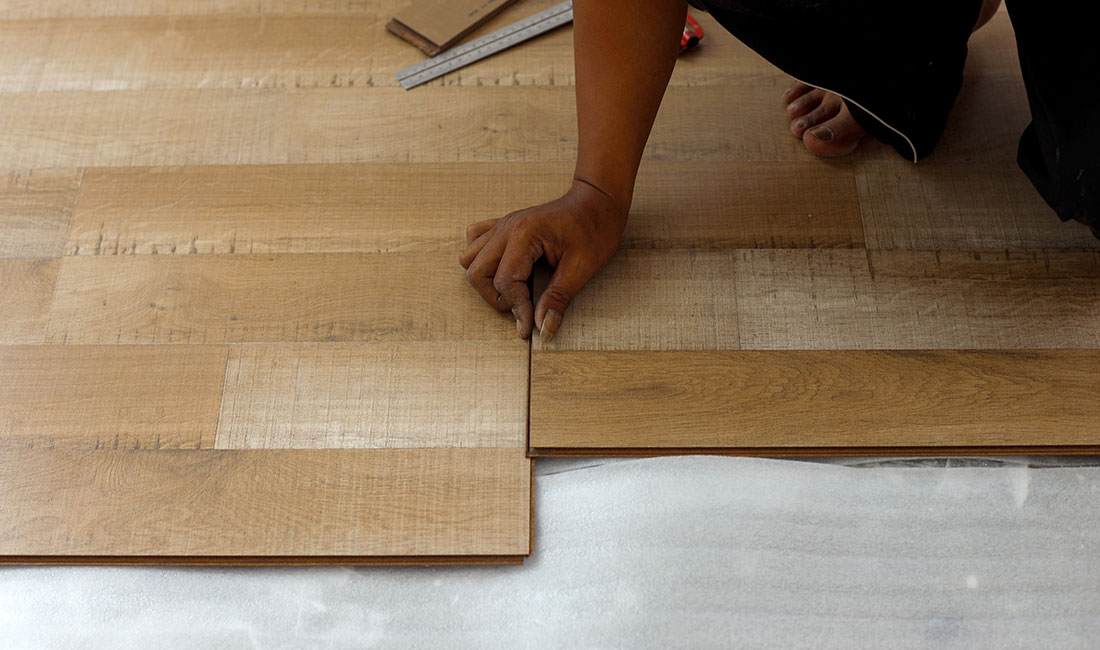
These properties let SPC float over concrete without glue in most basement conditions.
What thickness, wear layer, and low-profile advantages matter below grade?
Three specifications control basement performance.
Total plank thickness. Specify 4.0 mm as the minimum for residential basements. Choose 5.0 to 6.0 mm for heavy-traffic zones and rental units.
Wear layer thickness. Use the mil measurement, not the mm measurement, when comparing products.
● 12 mil: Light residential foot traffic
● 20 mil: Heavy residential, home gyms, and playrooms
● 22+ mil: Commercial basements and rental properties
Low profile. A 5 mm SPC plank plus a 1.5 mm underlayment adds only 6.5 mm to the slab. Hard-tile systems often add 25 to 40 mm of build-up. In basements with low ceilings, this gap can decide whether the room meets local code for headroom.
How Does SPC Compare to Other Basement Flooring Options?
SPC outperforms WPC, laminate, and engineered wood in basements because it has no fiber-based core. Against porcelain tile, epoxy, or polished concrete, SPC wins on underfoot comfort, installation speed, and warmth, while trading some abrasion resistance.
SPC vs. WPC and glue-down LVT — which rigid-core format wins below grade?
Three rigid-core vinyl types compete for basement work.
● SPC uses a stone-polymer core. It is the most stable under temperature swings. Best for cold, damp, or flood-prone basements.
● WPC uses a wood-polymer core. It feels softer underfoot but expands slightly more with heat. Acceptable for dry, climate-controlled basements only.
● Glue-down LVT uses a flexible vinyl sheet bonded directly to the slab. It is stable and low-profile, but the slab must be perfectly level and dry, which is rare in basements.
For most below-grade jobs, SPC is the safer default.
SPC vs. laminate and engineered wood — why do fiber cores still fail?
Both laminate and engineered wood use a high-density fiberboard (HDF) or wood core. HDF absorbs moisture even when the surface layer is coated. Field data shows:
● HDF swells 8% to 15% after 24 hours of water contact.
● Core swelling causes edge peaking, lock-joint separation, and permanent plank damage.
● Most manufacturer warranties exclude below-grade installation for these products.
Laminate and engineered wood are not suitable for basements with any moisture history.
SPC vs. porcelain tile, epoxy, and polished concrete — when do hard surfaces make sense?
These three options are also 100% waterproof, but the trade-offs differ.
| Option | Strengths | Weaknesses in basements |
| Porcelain tile | Highest abrasion resistance, 50+ year lifespan | Cold underfoot, needs flat slab, 25–40 mm build-up, grout stains |
| Epoxy coating | Seamless, chemical-resistant, low profile | Unforgiving on a cold slab, needs perfect surface prep, no cushion |
| Polished concrete | Lowest cost over an existing slab | Very cold, hard on joints, shows every crack |
SPC offers a middle path: full waterproofing, warmer surface, faster install, and realistic wood or stone looks.
What Are the Advantages and Disadvantages of SPC in Basements?
SPC’s advantages in basements are full waterproofing, dimensional stability, floating installation, and low maintenance. Disadvantages include a harder underfoot feel, cooler surface temperature in winter, and strict subfloor flatness requirements that some older slabs cannot meet without preparation.
What are SPC’s key advantages for below-grade applications?
● 100% waterproof core. No swelling after sustained water contact.
● Dimensional stability. Plank movement stays under 0.1% across typical basement temperature swings.
● Floating installation. No adhesive required on level slabs.
● Low maintenance. A dry mop and a neutral cleaner handle routine care.
● Easy repair. Individual planks can be lifted and replaced from the wall inward.
What trade-offs and limitations should you plan for?
● Harder underfoot feel. The rigid core transmits impact more than WPC or carpet.
● Cooler surface in winter. An unheated basement slab stays at 12°C to 15°C year-round.
● Flatness requirement. Subfloor must be flat within 3 mm over any 3-meter span.
● Not a leak fix. SPC protects the floor from water damage, but it does not repair active seepage through walls.
A good specifier plans for all four points before placing an order.
How Much Does Basement Waterproof Flooring Cost — and Is the ROI Worth It?
Basement SPC flooring costs 2.50to2.50to7.00 per square foot for materials and 5.50to5.50to11.00 installed. SPC delivers the strongest ROI for most homeowners because it combines full waterproofing, DIY-friendly installation, and strong resale appeal for finished basements.
SPC sits in the middle of the basement flooring cost range. The table below shows typical 2026 price bands in USD per square foot.
| Material | Material only | Installed |
| Polished concrete | 1.50–1.50–3.50 | 3.00–3.00–6.00 |
| Peel-and-stick vinyl | 1.00–1.00–2.50 | 2.50–2.50–5.00 |
| Laminate (water-resistant) | 1.50–1.50–4.00 | 4.00–4.00–7.50 |
| SPC flooring | 2.50–2.50–7.00 | 5.50–5.50–11.00 |
| WPC flooring | 3.00–3.00–8.00 | 6.00–6.00–12.00 |
| Epoxy coating | 3.00–3.00–7.00 | 5.00–5.00–12.00 |
| Porcelain tile | 4.00–4.00–10.00 | 12.00–12.00–27.00 |
ROI signals for SPC:
● Real estate listings with a finished SPC basement floor typically recover 70% to 80% of material cost at resale.
● SPC adds minimal build-up, so ceiling height and room feel stay intact.
● Replacement cycle runs 20 to 30 years, versus 5 to 10 years for basement carpet.
For most projects, SPC offers the best cost-to-performance balance among 100% waterproof options.
Which Failure Modes Cause the Most Callbacks on Basement Installations?
The top five failure modes are skipping slab moisture testing, poor subfloor prep, missing or wrong-thickness vapor retarders, incorrect expansion gaps, and improper acclimation. Each one can trigger edge curl, buckling, or lock-joint separation within the first year of service.
Why does skipping slab moisture testing undo every other safeguard?
A slab can look dry and still release too much vapor for any floor to hold. Two tests catch this risk.
- Calcium chloride test (ASTM F1869). Measures moisture vapor emission rate (MVER) in pounds per 1,000 square feet per 24 hours. SPC typically tolerates up to 12 lbs maximum.
- Relative humidity probe (ASTM F2170). Measures internal slab humidity. SPC typically tolerates up to 85% RH maximum.
Skipping these tests is the single biggest root cause of basement callbacks. One test costs under 50 and can preventa 50 and can preventa 10,000 rework.
Why does inadequate subfloor prep lead to peaking and gapping?
SPC is rigid but not magic. If the slab has bumps or voids deeper than 3 mm over 3 meters, plank edges will eventually peak upward. Grind high spots flat. Fill low spots with a self-leveling compound rated for below-grade use.
How do missed vapor retarders or wrong-thickness membranes cause edge curl and cupping?
A 6-mil polyethylene sheet is the industry minimum under a floating SPC floor. For wetter basements, specify a 10-mil or 15-mil membrane that meets ASTM E1745. Dimpled HDPE subfloor systems add an air gap that vents residual moisture and raises the plank above the cold slab.
Skipping the membrane causes edge curl within 6 to 18 months.
Why do incorrect expansion gaps trigger buckling and lock-joint separation?
SPC expands roughly 0.1% per 10°C temperature swing. A 10-meter basement floor needs at least 8 to 10 mm of gap at every wall. Plank ends that touch a wall or a fixed column will buckle during summer heat.
What acclimation and temperature mistakes shorten product life?
Acclimate SPC flat, in the installation room, for 48 hours before laying. Keep the room between 18°C and 27°C for three days before and after installation. Rapid cooling or heating in the first week triggers edge-joint stress that never fully recovers.
How Do You Choose the Right Waterproof Flooring for Your Basement?
Choose SPC when moisture risk is moderate to high, usage is heavy, or the basement includes a gym, playroom, home theater, or rental unit. Choose glue-down LVT, porcelain tile, or epoxy when the slab is unusually level, cold, or commercial-grade.
When should you specify SPC for a basement?
Pick SPC for any of these scenarios.
- Home gym. The rigid core handles dropped weights better than WPC or laminate.
- Home theater or family room. Click-lock SPC installs fast and stays quiet with a proper underlayment.
- Kids’ playroom. Spill-resistant, easy to mop, replaceable plank by plank.
- Home office. Chair-wheel resistant with a 20 mil wear layer.
- Basement apartment or rental unit. Low maintenance, easy turnover, long replacement cycle.
- Flood-risk zones. SPC can often be lifted, dried, and reinstalled after short-term flooding.
When is glue-down LVT, porcelain tile, or epoxy the better fit?
Other options win in specific cases.
- Glue-down LVT. Best when headroom is extremely tight and the slab is verified flat and dry. Full adhesion eliminates movement.
- Porcelain tile. Best for 20+ year ownership horizons or basement bathrooms.
- Epoxy coating. Best for workshops, storage zones, or commercial basements where a seamless hard surface is a bonus.
What specification questions should you send your supplier?
Send this list to every potential supplier before ordering.
- What is the core density, in g/cm³?
- What is the wear layer thickness, in mil?
- Does the below-grade warranty cover full residential or commercial use?
- What is the maximum allowed slab MVER and RH per ASTM F1869 and F2170?
- Do you provide third-party FloorScore, CE, or ISO test reports?
- What is the minimum recommended expansion gap?
- Is an attached underlayment included, and what is the IIC sound rating?
A reputable manufacturer answers all seven in one email.
FAQ — Basement Waterproof Flooring, Answered
SPC installs directly over concrete with a vapor barrier, stays stable without radiant heat, can survive short floods, and may be reused after drying. It does not replace a radon mitigation system but works alongside one.
Can SPC flooring be installed directly over a concrete basement slab?
Yes. Grind the slab flat within 3 mm over 3 meters. Lay a 6-mil to 10-mil polyethylene vapor barrier. Float the SPC planks on top. No glue is required in most cases.
Do I still need a moisture barrier or dimpled membrane beneath SPC?
Yes in almost every case. A flat vapor barrier works for dry slabs. A dimpled HDPE membrane with an air gap works better in damp basements or on slabs with a history of seepage.
Will SPC feel cold underfoot — and is radiant heat compatible?
SPC runs slightly cooler than carpet but warmer than tile. Most SPC planks are rated for radiant heat up to 28°C at the surface. Confirm the maximum with the manufacturer before installing.
Can SPC survive a basement flood, and can it be reused afterward?
Short floods under 24 hours usually leave SPC planks undamaged. Lift the planks, dry the slab and the back of each plank, replace the vapor barrier, and relay. The lock joints often survive one to two reinstalls.
Does SPC help with radon mitigation in below-grade spaces?
SPC and its vapor barrier reduce one pathway for radon gas, but they do not replace a dedicated radon mitigation system. Test your basement for radon before and after flooring installation. Install sub-slab depressurization if levels exceed 4 pCi/L.
Final Takeaway
Basements are not like the rest of your house. The slab sweats. The air swings. The mold threat never sleeps. Waterproof flooring for basements must answer all three pressures at the same time.
SPC does this better than any fiber-core product and more comfortably than most hard surfaces. Specify 4 to 6 mm thickness, a 20 mil wear layer, and a certified vapor barrier. Test the slab before the first plank goes down. Leave proper expansion gaps. Follow the manufacturer’s acclimation window.
Do these five things, and you will not see callbacks.
If you are planning a basement project and need a reliable SPC partner with full test reports and below-grade warranty coverage, our team is ready to help.