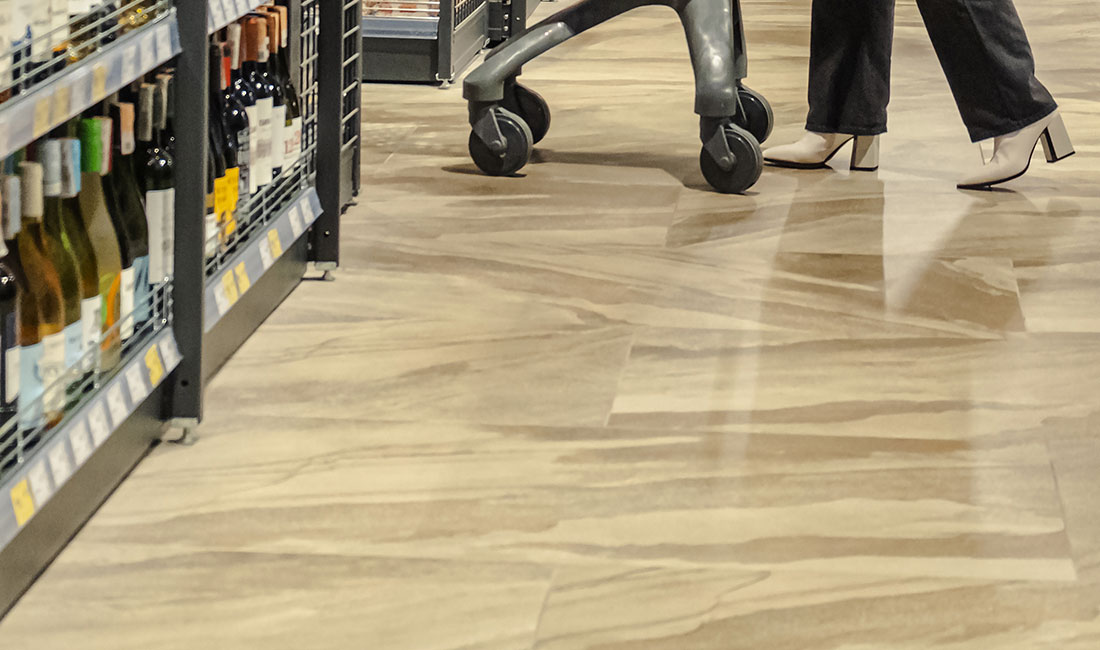
Retail floors face one of the toughest tests in commercial flooring. Shopping carts loaded with 150 kilograms roll across the same planks hundreds of times each day. Crowds track in dirt and moisture during peak hours. Display fixtures get moved and dragged across aisles without warning.
The right retail flooring combines a wear layer of at least 0.5 millimeters, a traffic classification of Class 33 or Class 34 under EN 685, and a construction method that prevents edge curl and delamination under rolling loads. Most retail floors fail early not because the product is defective, but because the specification ignored cart wheel pressure, thermal expansion in shopfront zones, or subfloor moisture limits. A floor rated for general commercial use will show wear paths within three years when placed in a supermarket main aisle.
This guide explains how to read the performance standards that separate a floor that survives from one that fails before its warranty expires. It covers the four main vinyl constructions used in retail, the specs that matter for cart traffic and slip resistance, and the questions buyers and contractors ask most when specifying floors for stores, malls, and showrooms.
What Is Retail High-Traffic Flooring and How Is Its Traffic Class Defined?
Retail high-traffic flooring is commercial-grade resilient flooring that is engineered to withstand heavy pedestrian flow, rolling cart loads, and frequent cleaning without visible wear. Under EN 685 / ISO 10874, it must meet Class 33 (heavy commercial) or Class 34 (very heavy commercial) performance thresholds.
Retailers must understand how European and international standards translate into real-world durability, and how daily operations like shopping carts and foot traffic create measurable mechanical stress on commercial flooring systems.
How EN 685 and ISO 10874 Classify Commercial Traffic Levels
EN 685 and ISO 10874 assign commercial spaces to four standardized traffic classes: Class 31 (light commercial), Class 32 (general commercial), Class 33 (heavy commercial), and Class 34 (very heavy commercial). Retail applications fall into Class 33 or Class 34 depending on customer density and operational intensity. Class 33 covers most retail stores and boutiques, while Class 34 is specified for high-traffic retail spaces such as mall anchors, supermarkets, and department stores.
Translating Crowds and Carts Into Measurable Floor Loads
A fully loaded shopping cart delivers approximately 150 kg distributed across four wheels, resulting in 37.5 kg of concentrated pressure per wheel contact point. Stiletto heels create point loads of 7 MPa compared to flat shoes at 0.1 MPa—a 70-fold difference in localized stress. Stocking trolleys in back-of-house areas routinely exceed 300 kg when fully loaded, requiring commercial flooring systems engineered to resist permanent indentation and surface puncture under these sustained loads.
Why Does Retail High-Traffic Flooring Fail Before Its Warranty Expires?
Retail high-traffic flooring fails through three physical mechanisms: abrasive wear that grinds away the protective top layer, residual indentation from static shelving and rolling cart loads, and delamination where subfloor moisture or install error breaks the bond between layers.
Abrasive Wear and Residual Indentation: The Two Dominant Failure Modes
A 0.3 mm wear layer lasts approximately 3 years in retail traffic, while 0.5 mm extends life to 8 years and 0.7 mm achieves 12+ years. EN 433 sets residual indentation threshold at 0.10 mm maximum after load removal, a limit exceeded when shopping carts concentrate 37.5 kg per wheel across small contact patches. EN 660-2 Group T provides the highest abrasion resistance class for commercial floors, required where stiletto point pressure reaches 7 MPa compared to flat-shoe loads of 0.1 MPa.

Delamination, Edge Curl, and Subfloor Moisture Failures
ASTM F1869 moisture vapor emission rate exceeding 5 lb per 1000 sq ft per 24 hours triggers adhesive breakdown, particularly when shopfront thermal swings reach 25°C between night and day. Click-lock installations over 500 square meter continuous spans experience movement stress that pulls edges upward, while glue-down systems fail when substrate moisture was not tested prior to installation. Moisture resistance depends on substrate preparation meeting manufacturer tolerances, as seasonal humidity cycles in retail spaces expose any gaps in pre-installation verification.
Which Performance Specs Must Retail High-Traffic Flooring Meet for Carts, Abrasion, and Slip?
Retail high-traffic flooring must meet four audited specs: a wear-layer group rating of T under EN 660-2, a castor-chair pass at 25,000 cycles under EN 425, a slip DCOF of 0.42 or higher under ANSI A326.3, and a fire rating of Bfl-s1 under EN 13501-1.
Wear Layer Thickness and Abrasion Class Requirements
A 0.3 mm (12 mil) wear layer delivers approximately 3 years in light commercial applications and fails prematurely in mall anchors and supermarkets; a 0.5 mm (20 mil) wear layer extends service to 8 years under general commercial traffic, and a 0.7 mm (28 mil) wear layer achieves 12+ years in heavy commercial retail environments. EN 660-2 Group T represents the highest abrasion resistance class for resilient flooring and is the minimum specification for retail corridors, checkout zones, and entrances. PEI 5 rating applies to ceramic and porcelain tile and indicates resistance to 12,000+ abrasion cycles, making it suitable for the same high-traffic retail zones that require 0.7 mm wear surfaces in resilient products.
Castor-Chair Cycles and Residual Indentation Thresholds
EN 425 requires the floor to pass 25,000 castor-chair cycles without visible damage, and EN 433 limits residual indentation to 0.10 mm maximum after a 150 N load is applied for 24 hours. A loaded shopping cart at 150 kg distributes force across four wheels at 37.5 kg per wheel, while a fully loaded stocking trolley can exceed 300 kg, concentrating point loads that test the core rigidity and wear surface of the flooring system. ASTM F970 Modified applies a 250 lb static load to simulate furniture and equipment pressure in back-of-house retail areas where indentation failure is common with under-specified resilient floors.
Slip Resistance and Fire Rating Compliance
ANSI A326.3 mandates a wet DCOF of 0.42 minimum for all hard-surface floors in interior commercial spaces, and DIN 51130 R10 covers dry retail traffic while R11 applies to food service areas, fresh produce zones, and any wet retail application. EN 13501-1 Bfl-s1 is the required fire rating for shopping malls and public retail spaces across the European Union, limiting flame spread and smoke production. DCOF values below 0.42 expose the specifier to slip-and-fall liability, particularly in entry zones and food courts where moisture and spills are frequent.
How Do LVT, SPC, WPC, and Loose Lay Compare as Retail High-Traffic Flooring?
For retail high-traffic flooring, SPC offers the highest dimensional stability and indentation resistance, LVT delivers the best design detail and thin-profile fit, WPC gives the quietest underfoot feel, and Loose Lay trades peak durability for fast, glue-free replacement on live-selling floors.
Introducing the Four Vinyl Constructions
LVT ranges from 2.0 to 5.0 mm total thickness with a fiberglass-reinforced backing and a PVC core, while SPC spans 4.0 to 8.0 mm built around a rigid core containing 60% or more calcium carbonate. WPC flooring measures 6.0 to 9.0 mm and uses a wood-PVC foam core for cushion, and Loose Lay products run 4.0 to 6.0 mm with high-density mineral filler plus a friction-grip backing that eliminates adhesive. All four qualify as luxury vinyl flooring under resilient flooring standards, but core composition determines load-bearing capacity, thermal movement, and installation method.
The Key Differences That Matter for Retail
ISO 23999 caps dimensional stability at 0.25% maximum linear change, a threshold SPC meets consistently due to its stone polymer composite core, while standard LVT and WPC require controlled acclimatization to avoid edge curl in shopfront thermal swings up to 25°C. Installation method splits between click-lock systems suited to spans under 500 m², glue-down applications for continuous floor areas above that limit, and Loose Lay formats that rest on friction alone. Subfloor flatness tolerance tightens to 3 mm per 2 m for click profiles, and single-point indentation recovery separates commercial-grade LVT with 0.10 mm residual maximum per EN 433 from lighter vinyl plank not rated for carts and crowds.
When to Choose Which: A Retail Zone-by-Zone Matrix
| Retail Zone | Construction | Wear Layer | Traffic Class | Installation |
| Entry & main aisle | SPC | 0.7 mm | Class 34 | Click-lock |
| Checkout & queue lines | SPC | 0.7 mm | Class 34 | Glue-down |
| Fitting room & boutique | LVT | 0.5 mm | Class 33 | Click-lock |
| Back-of-house & stock | Loose Lay | 0.5 mm | Class 32 | Friction lay |
| Pop-up shop & temporary | LVT | 0.3 mm | Class 32 |
Click-lock |
Entry and main aisle demand SPC click with 0.7 mm wear layer rated to Class 34 for loaded shopping carts at 150 kg total and stiletto point pressures reaching 7 MPa, while checkout zones require glue-down SPC to eliminate differential movement under static queues. Fitting rooms and boutique areas accept luxury vinyl tile at 0.5 mm in click format for design detail, back-of-house spaces favor Loose Lay for rapid replacement without floor closure, and pop-up installations use thin LVT click profiles that install over existing subfloor in under one day per 200 m².
What Are the Pros and Cons of Vinyl Retail High-Traffic Flooring?
Vinyl retail high-traffic flooring offers waterproof performance, quiet comfort, broad design variety, and fast installation, with lifecycle costs 30 to 50 percent below porcelain tile. Its trade-offs are UV fading near shopfronts, puncture risk from dropped fixtures, and the need for subfloor flatness below 3 mm per 2 m.
The Pros: Where Vinyl Outperforms Tile, Epoxy, and Carpet
Vinyl delivers 10-year TCO 30 to 50 percent below porcelain tile and requires only 3 to 5 days to install 1000 sq m versus 14 to 20 days for ceramic tile. Its 100% waterproof core with heat-welded seams eliminates grout maintenance and delamination from wet mopping, a persistent risk with epoxy grout over sealed concrete. Unlike commercial carpet tiles, vinyl resists permanent staining and does not harbor VOCs after installation; FloorScore-certified products meet strict indoor air quality thresholds. The 1500+ decor library spans wood, natural stone, and polished concrete looks, outpacing the narrow palette of VCT and quarry tile while matching the aesthetic range of large-format tiles and engineered hardwood.
The Cons and How to Spec Around Them
UV fading occurs within 3 m of shopfronts unless UV-stable series rated to ISO 4892-2 are specified, ruling out standard LVT in south- or west-facing displays. A 0.7 mm wear layer is mandatory for puncture resistance against dropped fixtures and shopping cart wheels carrying 37.5 kg per contact point, since 0.3 mm layers puncture in under three years. Subfloor flatness tolerance holds at 3 mm per 2 m per ASTM F710; deviations cause click-lock failure and edge curl over continuous spans above 500 sq m, necessitating glue-down SPC in main aisles. Vinyl is not rated below -20°C, disqualifying it for refrigerated receiving docks where commercial-grade porcelain and sealed concrete remain stable.
What Do Retail Buyers and Contractors Ask Most About Retail High-Traffic Flooring?
Retail buyers most often ask about minimum wear-layer thickness, cart-load tolerance, realistic replacement intervals, slip ratings for food-service zones, and whether click-lock or glue-down is safer for large continuous floor plates. Data-backed answers follow below.
What Is the Minimum Wear Layer for a Retail Store?
General retail stores require a minimum wear layer of 0.5 mm (20 mil) to meet EN 660-2 Group T abrasion resistance, while mall anchors and supermarkets require 0.7 mm (28 mil) for EN 685 Class 34 heavy commercial use. A 0.3 mm wear layer delivers approximately 3 years of service, 0.5 mm delivers approximately 8 years, and 0.7 mm delivers 12+ years under constant foot traffic and shopping cart loads.
Can SPC Click Flooring Handle Shopping Cart Traffic?
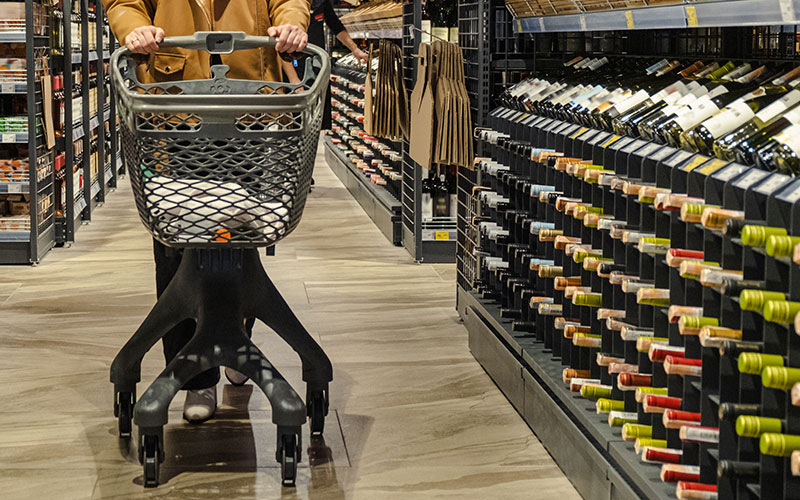
SPC click flooring handles shopping cart traffic when it passes EN 425 castor chair testing for 25,000 cycles and EN 433 residual indentation testing with a maximum 0.10 mm threshold. A loaded shopping cart applies 150 kg across four wheels, creating 37.5 kg per wheel, and requires a wear layer of at least 0.5 mm and a rigid CaCO₃ core density of 60% or higher to prevent edge curl and surface compression.
How Often Do Retail Vinyl Floors Actually Need Replacement?
Correctly specified vinyl flooring with a 0.7 mm wear layer and EN 685 Class 34 rating lasts 10 to 15 years in high-traffic retail environments, while under-specified floors with 0.3 mm wear layers require replacement in 3 to 5 years. Replacement intervals depend on initial wear-layer thickness, subfloor preparation to ASTM F710 flatness standards, and adherence to EN 433 indentation limits during the specification phase.
Is Glue-Down or Click-Lock Better for Large Retail Floor Plates?
Glue-down installation is required for continuous floor plates exceeding 500 square meters to prevent expansion-gap accumulation and edge lift, while click-lock installation works for refits over existing stable subfloors and spaces under 500 square meters. Glue-down provides superior dimensional stability per ISO 23999 (0.25% maximum movement) and eliminates the risk of joint separation under thermal cycling of up to 25°C in shopfront zones.
What Slip Rating Is Required for a Food Court or Supermarket?
Food courts and supermarkets require DIN 51130 R11 slip rating for wet zones and fresh produce areas, and ANSI A326.3 wet DCOF of 0.42 minimum for level interior walking surfaces expected to be wet. Dry retail areas require DIN 51130 R10 or ANSI A326.3 wet DCOF of 0.42 minimum, while entrance zones exposed to rain and snow require R11 or textured surfaces with enhanced slip resistance.
Frequently Asked Questions
What flooring materials perform best in high-traffic retail areas with shopping carts and heavy footfall?
Sheet vinyl with heat-welded seams and LVP with a 0.7 mm wear layer meet EN 685 Class 33 and Class 34 requirements for heavy and very heavy commercial traffic. Terrazzo and epoxy flooring systems offer exceptional abrasion resistance and can last the lifetime of the building when specified with proper aggregates and surface hardeners. Rubber flooring excels in slip resistance and impact absorption but is typically limited to back-of-house zones due to its more utilitarian appearance and susceptibility to staining from oils and certain cleaning agents.
How do LVP and sheet vinyl compare for durability, maintenance, and lifecycle cost in busy stores?
LVP with a rigid core and 0.5 mm wear layer offers straightforward click installation and can be replaced in sections without disrupting the entire floor, while sheet vinyl provides seamless, waterproof coverage with heat-welded seams that resist spills and moisture intrusion. Both materials deliver a 10-year total cost of ownership that runs 30 to 50 percent below porcelain tile when factoring in installation speed, downtime, and maintenance labor. Sheet vinyl typically requires professional installation and subfloor flatness within 3 mm per 2 m, whereas click-lock LVP can be installed over many existing surfaces and allows faster refit timelines of 3 to 5 days for 1,000 square meters.
When is rubber flooring the right choice for retail, and what are its trade-offs in appearance and cleaning?
Rubber flooring is the optimal choice for retail zones requiring maximum slip resistance, sound absorption, and impact protection, such as fitness showrooms, children’s departments, and stockrooms with heavy rolling loads. It meets DIN 51130 R11 ratings for wet environments and provides resilient cushioning that reduces fatigue for staff on their feet all day. The material’s design palette is limited primarily to solid colors or subtle flecked patterns, and it can be stained by petroleum-based products, certain floor finishes, and aggressive cleaning solvents that require pH-neutral maintenance protocols.
Which floor finishes and sealers hold up best under constant wear, frequent cleaning, and spill exposure?
Polyurethane and acrylic fortified sealers formulated for commercial traffic provide the necessary abrasion resistance and chemical tolerance for retail environments subject to daily wet mopping and periodic stripping. Terrazzo floors benefit from penetrating sealers that allow moisture vapor transmission while protecting the cement matrix, followed by topical densifiers that harden the surface and reduce porosity. Epoxy flooring systems with aliphatic topcoats resist UV yellowing in shopfront zones and maintain gloss retention under heavy foot traffic, while sheet vinyl and LVP require only pH-neutral cleaners and avoid wax-based finishes that can cause delamination or surface buildup.
How do terrazzo and epoxy flooring systems compare for long-term performance, repairability, and downtime during installation?
Terrazzo offers generational longevity and can be professionally refinished multiple times through honing and resealing, making it a low lifecycle cost investment despite higher upfront material and labor expenses. Epoxy flooring systems cure faster, with most high-build formulations ready for light traffic in 24 to 48 hours, compared to terrazzo’s multi-week installation and curing process that requires extended store closures or phased construction. Both flooring materials resist moisture, chemicals, and impact loads, but terrazzo provides unmatched design flexibility with custom aggregates and divider strips, while epoxy systems deliver seamless, joint-free surfaces ideal for food retail and areas requiring rigorous sanitation protocols.